All Animal Hospital Anomalies & How to Spot Them
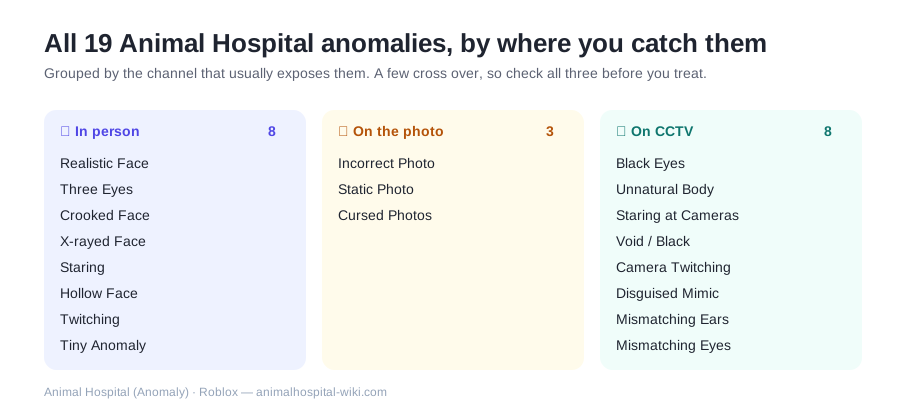
Anomalies are entities disguised as patients. There are three ways to catch one: look at it directly, take a polaroid, or check the CCTV — and each anomaly type only shows up through one of those channels. A single patient can stack several anomaly traits at once.
Anomaly Identifier
Mid-game and not sure? Pick where you noticed something off — get the matching anomalies and the correct play, instantly.
↑ Start by picking a channel. Rule of thumb: when in doubt, shutting the window is always safe — tasing a normal animal costs −15 sanity.
Ground rules for spotting Animal Hospital anomalies
- Letting an anomaly in usually triggers a Death Ritual, spawns a monster, or turns it into a Mimic that attacks patients and staff.
- Anomalies can't be knocked out (fainting and fire don't work). A wrong treatment kills them with no penalty but lowers your end-of-shift reward; the taser and gun also work.
- Tasing an anomaly gives +2 sanity; tasing or shooting a normal animal costs −15 sanity — be sure before you pull the trigger.
- If every patient seems handled but the shift won't end (no "The doctor is coming" message), one of the remaining "patients" is an anomaly.
👀 Visual anomalies
Spotted with the naked eye — no equipment needed.
| Anomaly | How to spot it / what to do |
|---|---|
| Realistic Face | Big eyes with dark pupils, heavy under-eye bags, and a grin that looks painted on rather than expressed. It speaks in a low, distorted voice — noticeably off from a normal patient's tone. |
| Three Eyes | Three misplaced, glowing red eyes replace the normal pair. Look closely and you can sometimes still make out the original two eyes underneath the extra set. |
| Crooked Face | A warped, tilted grin with sharp teeth, paired with mismatched eyes that sit visibly too high on the face — the proportions are just wrong in a way a normal patient's face never is. |
| X-rayed Face | Small, wide, round eyes with black pupils, combined with teeth that look unsettlingly real — almost too anatomically correct compared to the game's normal patient models. |
| Staring | Its head tracks you — or a random target in the room — constantly. In person the tracking is limited to roughly 60°, but on CCTV there's no limit at all, so the head can swivel further than a real neck should allow. Staring always turns into a Mimic during recovery. Even after a correct treatment, keep watching the room — this is one of the few anomalies where the danger isn't over when the paperwork is. |
| Hollow Face | Deep, pitch-black hollow eyes with no visible pupils, constant twitching, and a hunched, slouched posture. Hollow Face always triggers a Death Ritual during recovery. The correct play is simple: just shut the window on it. Rejecting it doesn't cost you anything on your end-of-shift results, so there's no reason to gamble on treating it. |
| Twitching | Spasming arms or head, a stretched neck, and a hunched back. Sometimes the twitching is only visible when you check the camera feed rather than looking at the patient directly. Twitching always becomes a Mimic in recovery — same rule as Staring. Watch the room for a bit after treatment instead of immediately moving to the next patient. |
| Tiny Anomaly | The patient is extremely small — far below any normal patient model — and speaks with a very high-pitched voice. Its only documented look so far is a pink bunny with a short tail and three glowing red eyes. It stays calm at the window, then turns hostile once checked in. It can also arrive during the Ambulance Event mixed in with genuine victims — size-check ambulance patients too. |
📸 Photo anomalies
Only visible on the polaroid. Regular anomaly photos don't cost sanity — only cursed photos do.
| Anomaly | How to spot it / what to do |
|---|---|
| Incorrect Photo (Different Eyes/Ears) | The polaroid doesn't match the patient standing at the window — different eye shape, different ear shape, or different ear color. A common example: bunny ears in person, but bear ears in the printed photo. |
| Static Photo | The photo comes out covered in visual static/grain instead of a clean image. Letting a Static Photo patient in triggers a Death Ritual. Given the June 22 accuracy change, treat any static photo as a reject-the-window situation rather than a shoot-to-confirm one. |
| Cursed Photos | The photo itself turns into a horror image — realistic eyes, a warped grin, bleeding eyes, and other variants have all been documented. |
📹 Camera anomalies
Only visible on the security cameras — always check CCTV before admitting anyone.
| Anomaly | How to spot it / what to do |
|---|---|
| Black Eyes | On the security camera feed, its face is covered by a black bar with a pair of unnervingly realistic eyes staring back through it. |
| Unnatural Body ("Boneless") | A severely stretched, warped body that only shows up on the camera feed. The shape actually changes each time you toggle the feed on and off, and even the printed photo distorts while the camera is open. |
| Staring at Cameras | Looks directly into the CCTV lens at all times — even while walking around, which a normal patient never does. |
| Void / Black | Appears entirely pitch black on the camera feed — no visible features at all, just a silhouette of solid black. |
| Camera Twitching | Twitches only when viewed through the camera feed — in person, the same patient looks completely normal. |
| Disguised Mimic | Shows its true Mimic form only on the camera feed. In person it looks completely normal all the way up until it reaches check-in. |
| Mismatching Ears | Ears or horns visible on the camera feed don't match what you see on the patient at the window. |
| Mismatching Eyes | Eye shape or color on the camera feed doesn't match the patient standing in front of you. |
Three pairs that get mixed up
Seven of the nineteen entries above are near-duplicates of each other, separated only by which channel shows the tell. Here is what actually tells each pair apart.
| The pair | What separates them |
|---|---|
| Staring vs Staring at Cameras | Staring tracks you — roughly 60° in person, unlimited on CCTV. Staring at Cameras holds eye contact with the lens itself, even while walking around. It is lens-awareness, not player-tracking. |
| Twitching vs Camera Twitching | Same tell, different channel. Twitching comes with a stretched neck and hunched back you can often see in person; Camera Twitching is camera-only, and the patient looks completely normal at the window. |
| Incorrect Photo vs Mismatching Ears / Eyes | Both are comparison checks against the patient in front of you — one compares the polaroid, the other compares the CCTV feed. Neither source is unusual on its own, so run both before you clear anyone. |
Field-tested tips
- A patient idling with a hunched, slouched posture is a Mimic or anomaly — every time.
- After Shift 10, static photos get unreliable as evidence — default to shutting the window instead of shooting.
- The Head Banger is special: tasing, shooting or shooing it costs −20 sanity. The right play is handing it a coffee (drink two sips first and you net +10 sanity).
- A patient dropping slime is not proof of an anomaly.
- If a room catches fire and the patient inside doesn't faint — that's a Mimic, 100%.
- After treating someone, linger outside the room for a minute: Mimics often mutter "I'm hungry..." or "I feel funny..." right before turning.
Keep reading
Verified against community data. Last checked: August 31, 2026.